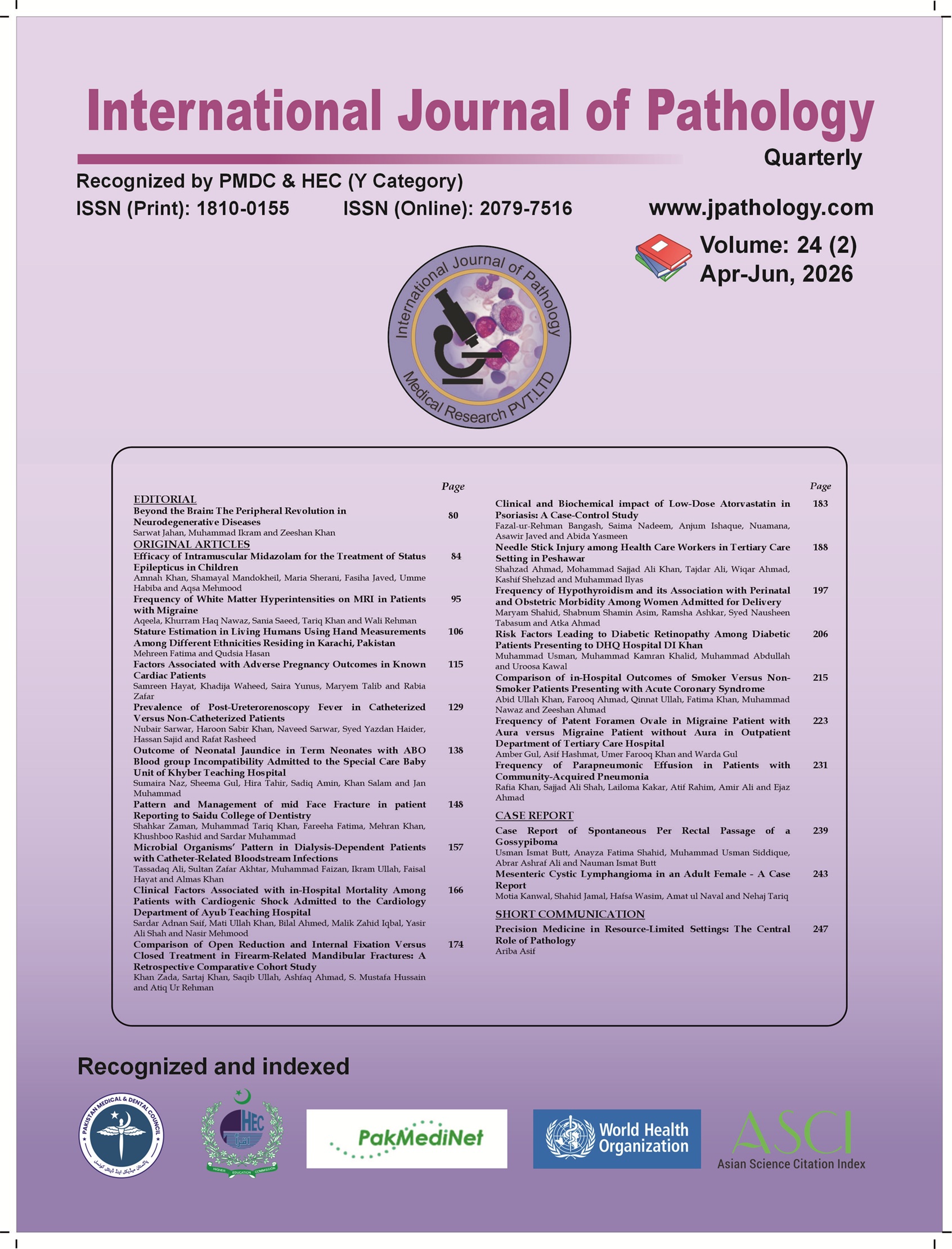
Frequency of hypothyroidism and its association with perinatal and obstetric morbidity among women admitted for delivery
DOI:
https://doi.org/10.59736/IJP.24.02.1075Keywords:
Hypothyroidism, Obstetric Outcomes, Perinatal Outcomes, Pregnancy, Subclinical Hypothyroidism, Thyroid DysfunctionAbstract
Background: Hypothyroidism is a common endocrine disorder in pregnancy and may adversely affect maternal and fetal outcomes. Limited local data are available regarding thyroid dysfunction among women presenting for delivery. This study aimed to determine the frequency of hypothyroidism and its association with obstetric and perinatal morbidity.
Methods: This hospital-based cross-sectional study was conducted at the Department of Obstetrics and Gynecology, Abbasi Shaheed Hospital, Karachi, over six months. A total of 400 pregnant women aged 18–45 years with singleton pregnancies admitted for delivery were enrolled through non-probability consecutive sampling. Thyroid function tests were performed at admission, and participants were classified as euthyroid, subclinical hypothyroid, or overt hypothyroid. Obstetric and perinatal outcomes were recorded and analyzed using SPSS version 25, with p<0.05 considered statistically significant.
Results: Among 400 women, 287 (71.8%) were euthyroid and 113 (28.2%) had hypothyroidism, including 97 (24.3%) subclinical and 16 (4.0%) overt cases. No significant association was found between hypothyroidism and preeclampsia (p = 0.274), preterm delivery (p = 0.301), cesarean section (p = 0.819), low birth weight (p = 0.392), NICU admission (p = 0.926), or neonatal mortality (p = 0.279).
Conclusion: Hypothyroidism, particularly subclinical hypothyroidism, was relatively common among women admitted for delivery. However, no significant association was observed with the evaluated obstetric or perinatal outcomes. Larger prospective studies are required to clarify the role of thyroid dysfunction in pregnancy and guide future screening strategies.
References
Knøsgaard L, Andersen S, Hansen AB, Vestergaard P, Andersen SL. Maternal hypothyroidism and adverse outcomes of pregnancy. Clin Endocrinol (Oxf). 2023 May;98(5):719–29. doi:10.1111/cen.14853
Brown EDL, Obeng-Gyasi B, Hall JE, Shekhar S. The Thyroid Hormone Axis and Female Reproduction. Int J Mol Sci. 2023 Jun 6;24(12):9815. doi:10.3390/ijms24129815
Kim JH, Moon N, Heo SJ, Lee YJ, Hwang JY, Lee SJ, et al. Impact of endocrine disrupting chemical exposure on thyroid disruption and oxidative stress in early pregnancy. Environ Anal Health Toxicol. 2025 Jan 22;40(1):e2025002. doi:10.5620/eaht.2025002
Vamja R, M Y, Patel M, Vala V, Ramachandran A, Surati B, et al. Impact of maternal thyroid dysfunction on fetal and maternal outcomes in pregnancy: a prospective cohort study. Clin Diabetes Endocrinol. 2024 Dec 19;10(1):50. doi:10.1186/s40842-024-00212-6
Yadav V, Dabar D, Goel AD, Bairwa M, Sood A, Prasad P, et al. Prevalence of Hypothyroidism in Pregnant Women in India: A Meta-Analysis of Observational Studies. Stack Jr. BC, editor. J Thyroid Res. 2021 Feb 19;2021:1–19. doi:10.1155/2021/5515831
Nigatie M, Kumie G, Jemal A, Gedfie S, Kassahun W, Gashaw M, et al. Prevalence of thyroid dysfunction among pregnant women in the horn of Africa: A systematic review and Meta-analysis. Endocr Metab Sci. 2024 Sep;16:100200. doi:10.1016/j.endmts.2024.100200
Dhanwal D, Bajaj S, Rajput R, Subramaniam KAV, Chowdhury S, Bhandari R, et al. Prevalence of hypothyroidism in pregnancy: An epidemiological study from 11 cities in 9 states of India. Indian J Endocrinol Metab. 2016;20(3):387. doi:10.4103/2230-8210.179992
Capozzi A, Scambia G, Lello S. Subclinical hypothyroidism in women’s health: from pre- to post-menopause. Gynecol Endocrinol. 2022 May 4;38(5):357–67. doi:10.1080/09513590.2022.2046728
Eshkoli T, Burrack N, Gordon-Irshai A, Cohen B, Fraenkel M, Yoel U. Maternal Overt Hypothyroidism and Pregnancy Complications: Insights from a Nationwide Cross-Sectional Study. J Clin Med. 2025 Jul 25;14(15):5278. doi:10.3390/jcm14155278
Idris I, Srinivasan R, Simm A, Page RC. Maternal hypothyroidism in early and late gestation: effects on neonatal and obstetric outcome. Clinical endocrinology. 2005 Nov;63(5):560-5.
Wang X, Zhang E, Tian Z, Zhao R, Huang K, Gao S, et al. The association between dyslipidaemia in the first trimester and adverse pregnancy outcomes in pregnant women with subclinical hypothyroidism: a cohort study. Lipids Health Dis. 2024 Jan 11;23(1):13. doi:10.1186/s12944-023-01998-7
Lucaccioni L, Ficara M, Cenciarelli V, Berardi A, Predieri B, Iughetti L. Long term outcomes of infants born by mothers with thyroid dysfunction during pregnancy. Acta Bio Medica: Atenei Parmensis. 2020 Sep 15;92(1):e2021010.
Hizkiyahu R, Badeghiesh A, Baghlaf H, Dahan MH. Associations between hypothyroidism and adverse obstetric and neonatal outcomes: a study of a population database including over 184,000 women with hypothyroidism. J Matern Fetal Neonatal Med. 2023 Dec 15;36(2):2278027. doi:10.1080/14767058.2023.2278027
Korevaar TIM, Leung AM, Alexander EK, Bliddal S, Boelaert K, Brenta G, et al. American Thyroid Association 2026 Guidelines for Thyroid Disease in Preconception, Pregnancy, and Postpartum. Thyroid®. 2026 May 1;36(5):481–544. doi:10.1177/10507256261445624
Liu L, He W, Zhu J, Deng K, Tan H, Xiang L, et al. Global prevalence of congenital hypothyroidism among neonates from 1969 to 2020: a systematic review and meta-analysis. Eur J Pediatr. 2023 Apr 18;182(7):2957–65. doi:10.1007/s00431-023-04932-2
Wei R, Wang Z, Zhang X, Wang X, Xu Y, Li Q. Burden and trends of iodine deficiency in Asia from 1990 to 2019. Public Health. 2023 Sep;222:75–84. doi:10.1016/j.puhe.2023.06.034
Ali T, Bahadur A, Bashir B, Hassan T, Ishaq B, Qasim M. Prevalence of Hypothyroidism in Pregnancies and its Obstetric Outcomes. Pak J Med Health Sci. 2022 Mar 30;16(3):1184–6. doi:10.53350/pjmhs221631184
Dhabhai N, Chowdhury R, Virmani A, Chaudhary R, Taneja S, Mittal P, et al. Burden, risk factors and outcomes associated with adequately treated hypothyroidism in a population-based cohort of pregnant women from North India. Jayakody S, editor. PLOS ONE. 2023 Sep 13;18(9):e0282381. doi:10.1371/journal.pone.0282381
Wyne KL, Nair L, Schneiderman CP, Pinsky B, Antunez Flores O, Guo D, et al. Hypothyroidism Prevalence in the United States: A Retrospective Study Combining National Health and Nutrition Examination Survey and Claims Data, 2009–2019. J Endocr Soc. 2022 Nov 17;7(1):bvac172. doi:10.1210/jendso/bvac172
Kumar R, Bansal R, Shergill HK, Garg P. Prevalence of thyroid dysfunction in pregnancy and its association with feto-maternal outcomes: A prospective observational study from a tertiary care institute in Northern India. Clin Epidemiol Glob Health. 2023 Jan;19:101201. doi:10.1016/j.cegh.2022.101201
Ghimire A, Ghimire S, Baniya P, Pant SR, Subedi N, Koirala P, et al. Hypothyroidism among Pregnant Women Attending the Outpatient Department of Obstetrics in a Tertiary Care Centre: A Descriptive Cross-sectional Study. J Nepal Med Assoc. 2023 Jun 1;61(262):495–8. doi:10.31729/jnma.8184
Han Y, Wang J, Wang X, Ouyang L, Li Y. Relationship Between Subclinical Hypothyroidism in Pregnancy and Hypertensive Disorder of Pregnancy: A Systematic Review and Meta-Analysis. Front Endocrinol. 2022 Mar 8;13:823710. doi:10.3389/fendo.2022.823710
Amouzegar A, Dehghani M, Abdi H, Mehran L, Masoumi S, Azizi F. Natural history of subclinical hypothyroidism and prognostic factors for the development of overt hypothyroidism: Tehran Thyroid Study (TTS). J Endocrinol Invest. 2022 Aug 4;45(12):2353–64. doi:10.1007/s40618-022-01876-6
Varner MW, Mele L, Casey BM, Peaceman AM, Reddy UM, Wapner RJ, et al. Progression of Gestational Subclinical Hypothyroidism and Hypothyroxinemia to Overt Hypothyroidism After Pregnancy: Pooled Analysis of Data from Two Randomized Controlled Trials. Thyroid®. 2024 Sep;34(9):1171–6. doi:10.1089/thy.2023.0616
Additional Files
Published
Issue
Section
License
Copyright (c) 2026 Maryam Shahid, Shabnum Shamim Asim , Ramsha Ashkar , Syeda Nousheen Tabasum , Atka Ahmad

This work is licensed under a Creative Commons Attribution-NonCommercial 4.0 International License.
Readers may “Share-copy and redistribute the material in any medium or format” and “Adapt-remix, transform, and build upon the material”. The readers must give appropriate credit to the source of the material and indicate if changes were made to the material. Readers may not use the material for commercial purpose. The readers may not apply legal terms or technological measures that legally restrict others from doing anything the license permits.