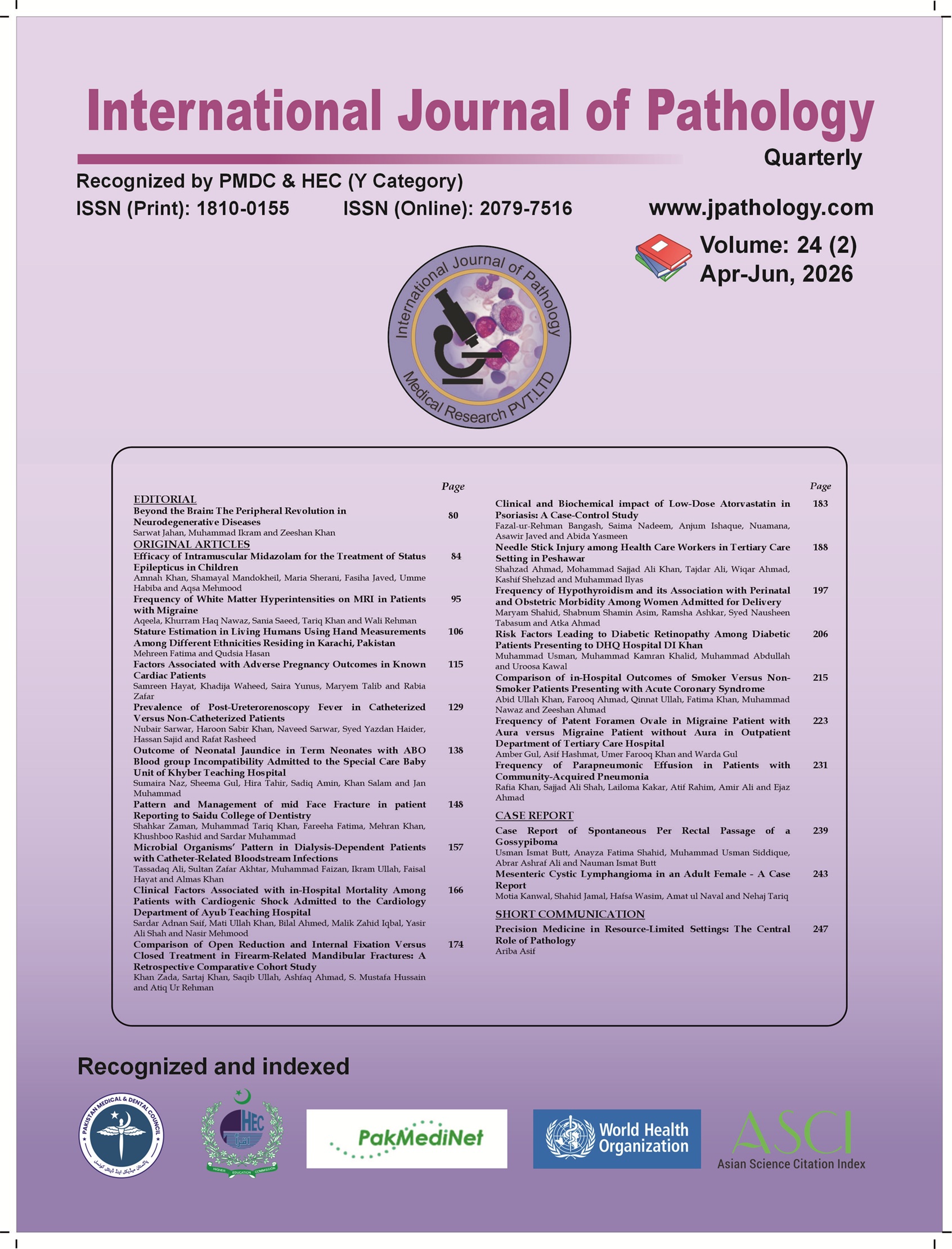
Comparison of open reduction and internal fixation versus closed treatment in firearm-related mandibular fractures: a retrospective comparative cohort study
DOI:
https://doi.org/10.59736/IJP.24.02.1085Keywords:
Facial Asymmetry, Firearms Injury, Mandibular Fractures, Postoperative Complications, Retrospective StudiesAbstract
Background: Firearm-related mandibular fractures are increasingly encountered in tertiary care settings and are associated with complex injury patterns and significant morbidity. Optimal management remains debated, particularly between open reduction and internal fixation (ORIF) and closed treatment approaches.
Methods: This retrospective comparative cohort study was conducted at Mardan Medical Complex, Khyber Pakhtunkhwa, Pakistan, from April 2024 to December 2025. A total of 202 patients with firearm-related mandibular fractures were included and categorized into ORIF (n=157) and closed treatment (n=45) groups. Outcomes included infection, non-union, malocclusion, facial asymmetry, healing time, and functional recovery. Multivariable logistic regression was performed to adjust for confounders.
Results: Non-union (15.6% vs. 4.5%, p=0.01), malocclusion (22.2% vs. 7.6%, p=0.005), and facial asymmetry (20.0% vs. 6.4%, p=0.004) were significantly higher in the closed group. Infection rates were comparable (p=0.32). ORIF demonstrated shorter healing time and improved functional recovery. Adjusted analysis confirmed higher odds of non-union (aOR 3.82), malocclusion (aOR 2.94), and facial asymmetry (aOR 2.78) with closed treatment.
Conclusion: ORIF provides superior structural and functional outcomes compared to closed treatment in firearm-related mandibular fractures and should be preferred when feasible.
References
Fontanarosa PB, Bibbins-Domingo K. The unrelenting epidemic of firearm violence. Jama. 2022;328(12):1201–3.
Li Y, Fan H, Gao XL. Ballistic helmets: Recent advances in materials, protection mechanisms, performance, and head injury mitigation. Compos Part B Eng. 2022;238:109890.
Hesham A, Geiger J, Alshamrani Y, Sawatari Y. Can the mechanism of injury impact the location of a mandibular fracture? A systematic review. J Maxillofac Oral Surg. 2024;23(2):363–70.
Ou Z, Ren Y, Duan D, Tang S, Zhu S, Feng K, et al. Global burden and trends of firearm violence in 204 countries/territories from 1990 to 2019. Front Public Health. 2022;10:966507.
Powers DB, Holmes J. Maxillofacial Firearm Injuries. In: Peterson’s Principles of Oral and Maxillofacial Surgery. Springer; 2022. p. 785–812.
Pepper T, Powers D. Open Versus Closed Management for Gunshot Wounds of the Mandible–Which More Frequently Achieves Satisfactory Bony Union? A Systematic Review and Meta-Analysis. J Oral Maxillofac Surg. 2025;83(7):852–62.
Rikhotso RE, Reyneke JP, Nel M. Does open reduction and internal fixation Yield better outcomes over closed reduction of mandibular condylar fractures? J Oral Maxillofac Surg. 2022;80(10):1641–54.
Aboelnaga AM, Elsahfy MF, Adly OA, Gomaa AA. Comparative Study between Open and Closed Reduction in Management of Subcondylar and Ramus Mandibular Fractures. Suez Canal Univ Med J. 2023;26(2):35–45.
Stefanopoulos PK, Breglia GA, Bissias C, Nikita AS, Papageorgiou C, Tsiatis NE, et al. Firearm Injuries: A Review of Wound Ballistics and Related Emergency Management Considerations. Emerg Care Med. 2025;2(4):52.
Daniels JS, Albakry I, Braimah RO, Samara MI, Albalasi RA, Al-Rayshan SMA. Management of Maxillofacial Gunshot Injuries With Emphasis on Damage Control Surgery During the Yemen Civil War. Review of 173 Victims From a Level 1 Trauma Hospital in Najran, Kingdom of Saudi Arabia. Craniomaxillofacial Trauma Reconstr. 2022 Mar;15(1):58–65. doi:10.1177/19433875211012211
Brauner E, Laudoni F, Amelina G, Cantore M, Armida M, Bellizzi A, et al. Dental Management of Maxillofacial Ballistic Trauma. J Pers Med. 2022 Jun 5;12(6):934. doi:10.3390/jpm12060934
Bourn L, Slovacek C, Lu N, Pocha CC, Wilbert H, Chen C, et al. Managing Low-Velocity Mandibular Gunshot Wounds: An Institutional Review and the “FLOSS” Severity Scoring System. J Craniofac Surg. 2025 Mar;36(2):518–22. doi:10.1097/SCS.0000000000010963
Da Rocha SS, Sales PHDH, Carvalho PHR, Maia RN, Gondim RF, De Menezes Junior JMS, et al. Mandibular traumas by gunshot. A systematic review with meta-analysis and algorithm of treatment. Br J Oral Maxillofac Surg. 2021 Apr;59(3):e99–108. doi:10.1016/j.bjoms.2020.08.019
Pepper T, Powers D. Open Versus Closed Management for Gunshot Wounds of the Mandible – Which More Frequently Achieves Satisfactory Bony Union? A Systematic Review and Meta-Analysis. J Oral Maxillofac Surg. 2025 Jul;83(7):852–62. doi:10.1016/j.joms.2025.04.003
Shobha ES, Nainoor N, Prashanth NT, Rangan V, Malick R, Shetty S. Comparative Evaluation of Open Reduction with Internal Fixation Against Closed Reduction Methods for Condylar Fracture Management: A Systematic Review and Meta- analysis. J Maxillofac Oral Surg. 2024 Jun;23(3):475–87. doi:10.1007/s12663-024-02125-4
Agier P, Tyszkiewicz S, Kozakiewicz M. Effectiveness of Open Rigid Internal Fixation of Condylar Fracture Resulting in Temporomandibular Joint Function Recovery. Dent J. 2025 Dec 1;13(12):562. doi:10.3390/dj13120562
Rashid S, Kumar RD, Kalimuddin KS. Closed treatment versus open reduction and internal fixation for mandibular condylar head fractures: A systematic review and meta-analysis. J Cranio-Maxillofac Surg. 2026 Jul;54(7):104560. doi:10.1016/j.jcms.2026.104560
Jazayeri HE, Lopez J, Khavanin N, Xun H, Lee UK, Best DL, et al. Comparative Benefits of Open versus Closed Reduction of Condylar Fractures: A Systematic Review and Meta-Analysis. Plast Reconstr Surg. 2023 Apr;151(4):664e–72e. doi:10.1097/PRS.0000000000010009
Comparison of Outcomes Between Open and Closed Reduction for Mandibular Condylar Fractures. J Coll Physicians Surg Pak. 2026 Jan 1;17–21. doi:10.29271/jcpsppg.2026.01.17
Published
Issue
Section
License
Copyright (c) 2026 Khan Zada, Sartaj Khan, Saqib Ullah, Ashfaq Ahmad, S. Mustafa Hussain, Atiq ur Rehman

This work is licensed under a Creative Commons Attribution-NonCommercial 4.0 International License.
Readers may “Share-copy and redistribute the material in any medium or format” and “Adapt-remix, transform, and build upon the material”. The readers must give appropriate credit to the source of the material and indicate if changes were made to the material. Readers may not use the material for commercial purpose. The readers may not apply legal terms or technological measures that legally restrict others from doing anything the license permits.