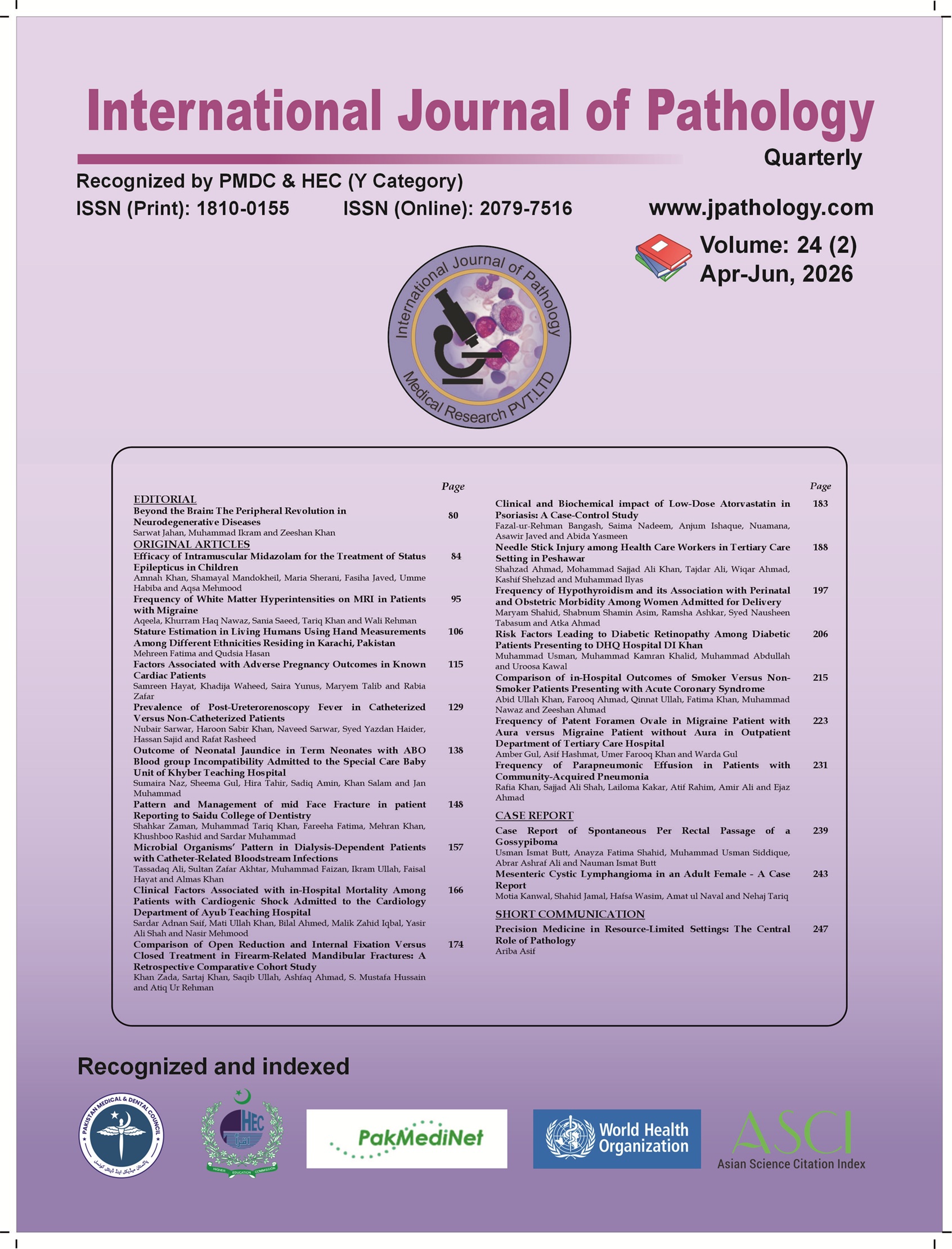
Clinical factors associated with in-hospital mortality among patients with cardiogenic shock admitted to the cardiology department of Ayub Teaching Hospital
DOI:
https://doi.org/10.59736/IJP.24.02.1081Keywords:
Cardiogenic Shock, Hypertension, Risk Factors, Type 2 Diabetes MellitusAbstract
Background: Cardiogenic shock (CS) is the most common complication of acute myocardial infarction. Our aim is to define the rate of in-hospital mortality and to evaluate the chosen clinical variables that relate to mortality in patients with cardiogenic shock.
Methods: A Hospital based descriptive observational study was conducted at the Department of cardiology, Ayub teaching hospital, Abbottabad from June 2025 to December 2025.There were 129 patients with cardiogenic shock aged 40-80 years, both male and females. Patients in cardiogenic or non-cardiogenic shock (e.g. septic, hypovolemic or anaphylactic shock), end-stage renal or hepatic failure, post cardiac surgical status, traumatic cardiac injury, pregnant or lactating women were excluded. During the admission process, demographic and clinical data such as age, sex, body mass index, symptoms duration, smoking status, socioeconomic status, occupation, education level, and location were taken in a systematic manner. Hospital follow-ups were done with the admitted patients throughout the hospital stay and the outcome was the in-hospital mortality. The relationship between the chosen clinical factors and mortality were determined.
Results: 35 (27.13%) patients were noted to die in-hospital. Among patients who died, male sex was present in 24 (68.57%), advanced age in 13 (37.14%), diabetes mellitus in 16 (45.71%), hypertension in 22 (62.86%), and obesity in 14 (40.0%). Comparison between mortality and survival groups on variables with denominations: There was no statistically significant difference in mortality and survival at p<0.05; hypertension exhibited a non-significant tendency towards increased mortality (OR 2.01, 95% CI 0.90-4.45, p=0.084).
Conclusion: Older age, male sex, diabetes mellitus, hypertension and obesity were found among patients with in-hospital mortality although the comparative analysis at hand failed to prove these factors to be independent predictors.
References
Hamzaoui O, Boissier F. Hemodynamic monitoring in cardiogenic shock. J Intensive Med. 2022;3(2):104-13. DOI: https://doi.org/10.1016/j.jointm.2022.10.003
Yuen T, Senaratne JM. Definition, classification, and management of primary noncardiac causes of cardiogenic shock. Can J Cardiol. 2025;41(4):587-604. DOI: https://doi.org/10.1016/j.cjca.2024.12.014
Jung C, Bruno RR, Jumean M, Price S, Krychtiuk KA, Ramanathan K, et al. Management of cardiogenic shock: state-of-the-art. Intensive Care Med. 2024;50(11):1814-29. DOI: https://doi.org/10.1007/s00134-024-07618-x
Laghlam D, Benghanem S, Ortuno S, Bouabdallaoui N, Manzo-Silberman S, Hamzaoui O, et al. Management of cardiogenic shock: a narrative review. Ann Intensive Care. 2024;14(1):45-8. DOI: https://doi.org/10.1186/s13613-024-01260-y
Thiele H, Zeymer U, Akin I, Behnes M, Rassaf T, Mahabadi AA, et al. Extracorporeal life support in infarct-related cardiogenic shock. N Engl J Med. 2023;389(14):1286-97. DOI: https://doi.org/10.1056/NEJMoa2307227
Aissaoui N, Puymirat E, Delmas C, Ortuno S, Durand E, Bataille V, et al. Trends in cardiogenic shock complicating acute myocardial infarction. Eur J Heart Fail. 2020;22(4):664-72. DOI: https://doi.org/10.1002/ejhf.1750
Olarte N, Rivera NT, Grazette L. Evolving presentation of cardiogenic shock: a review of the medical literature and current practices. Cardiol Ther. 2022;11(3):369-84. DOI: https://doi.org/10.1007/s40119-022-00274-6
Javed N, Itare V, Allu SVV, Penikilapate S, Pandey N, Ali N, et al. Burden and predictors of mortality related to cardiogenic shock in the South Bronx population. Am J Cardiovasc Dis. 2024;14(6):355-67. DOI: https://doi.org/10.62347/HYCA6457
Jozwiak M, Lim SY, Si X, Monnet X. Biomarkers in cardiogenic shock: old pals, new friends. Ann Intensive Care. 2024;14(1):157-61. DOI: https://doi.org/10.1186/s13613-024-01388-x
Hashmi KA, Abbas K, Hashmi AA, Irfan M, Edhi MM, et al. In-hospital mortality of patients with cardiogenic shock after acute myocardial infarction: impact of early revascularization. BMC Res Notes. 2018;11(1):721-5. DOI: https://doi.org/10.1186/s13104-018-3830-7
Laghlam D, Benghanem S, Ortuno S. Management of cardiogenic shock: a narrative review. Ann Intensive Care. 2024;14(1):45. DOI: https://doi.org/10.1186/s13613-024-01260-y
Alkhunaizi FA, Smith N, Brusca SB. The Management of Cardiogenic Shock From Diagnosis to Devices: A Narrative Review. CHEST Crit Care. 2024;(2):100071. DOI: https://doi.org/10.1016/j.chstcc.2024.100071
Blumer V, Kanwar MK, Barnett CF. Cardiogenic Shock in Older Adults: A Focus on Age-Associated Risks and Approach to Management: A Scientific Statement From the American Heart Association. Circulation. 2024;149(14):1051-e1065. DOI: https://doi.org/10.1161/CIR.0000000000001214
Tyler JM, Brown C, Jentzer JC. Variability in reporting of key outcome predictors in acute myocardial infarction cardiogenic shock trials. Catheter Cardiovasc Interv. 2022;99(1):19-26. DOI: https://doi.org/10.1002/ccd.29710
Jentzer JC, Schrage B, Holmes DR, Dabboura S, Anavekar NS, Kirchhof P, et al. Influence of age and shock severity on short term survival in patients with cardiogenic shock. Eur Heart J Acute Cardiovasc Care. 2021; 10:604-612. DOI: https://doi.org/10.1093/ehjacc/zuaa035
Izadfar R, Ziaie N, Jalali F, Tayebi P, Ahangar HG. Predictors of 30-Day Mortality in Patients with Heart Failure Presenting with Cardiogenic Shock. Pak Heart J. 2025;58(01):17-23. DOI: https://doi.org/10.47144/phj.v58i1.2771
Acharya D. Predictors of outcomes in myocardial infarction and cardiogenic shock. Cardiol Rev. 2018;26:255-66. DOI: https://doi.org/10.1097/CRD.0000000000000190
Shah M, Patel B, Tripathi B, Agarwal M, Patnaik S, Ram P, et al. Hospital mortality and thirty-day readmission among patients with non-acute myocardial infarction related cardiogenic shock. Int J Cardiol. 2018; 270:60-67. DOI: https://doi.org/10.1016/j.ijcard.2018.06.036
Baran DA, Long A, Badiye AP, Stelling K. Prospective validation of the SCAI shock classification: single center analysis. Catheter Cardiovasc Interv. 2020; 96:1339-1347. DOI: https://doi.org/10.1002/ccd.29319
Damluji AA, Forman DE, van Diepen S, Alexander KP, Page RL 2nd, Hummel SL, et al. Older adults in the cardiac intensive care unit: factoring geriatric syndromes in the management, prognosis, and process of care: a scientific statement from the American Heart Association. Circulation. 2020;141. DOI: https://doi.org/10.1161/CIR.0000000000000741
Pourafkari L, Wang CK, Schwartz M, Nader ND. Does shock index provide prognostic information in acute heart failure? Int J Cardiol. 2016; 215:140-2. DOI: https://doi.org/10.1016/j.ijcard.2016.04.083
Schmitz T, Harmel E, Linseisen J, Kirchberger I, Heier M, Peters A, et al. Shock index and modified shock index are predictors of long term mortality not only in STEMI but also in NSTEMI patients. Ann Med. 2022;54(1):900-8. DOI: https://doi.org/10.1080/07853890.2022.2056240
Tolenaar JL, Froehlich W, Jonker FHW. Predicting in-hospital mortality in acute type B aortic dissection: evidence from International Registry of Acute Aortic Dissection. Circulation.2014;130(11Suppl1).DOI:https://doi.org/10.1161/CIRCULATIONAHA.113.007117
Luo C, Chen F, Liu L, Ge Z, Feng C, Chen Y. Impact of diabetes on outcomes of cardiogenic shock: a systematic review and meta-analysis. Diabetes Vasc Dis Res. 2022. DOI: https://doi.org/10.1177/14791641221132242
Sreenivasan J, Khan MS, Sharedalal P, Hooda U, Fudim M, Demmer RT, et al. Obesity and outcomes following cardiogenic shock requiring acute mechanical circulatory support.CircHeartFail.2021;14.DOI:https://doi.org/10.1161/CIRCHEARTFAILURE.120.007937
Hales CM, Carroll MD, Fryar CD, Ogden CL. Prevalence of obesity and severe obesity among adults: United States, 2017-2018. NCHS Data Brief. 2020;1-8. DOI: No DOI found / likely no DOI assigned.
Sharma A, Lavie CJ, Borer JS, Vallakati A, Goel S, Lopez-Jimenez F, et al. Meta-analysis of the relation of body mass index to all-cause and cardiovascular mortality and hospitalization in patients with chronic heart failure. Am J Cardiol. 2015; 115:1428-34. DOI: https://doi.org/10.1016/j.amjcard.2015.02.024
Carbone S, Lavie CJ. Disparate effects of obesity on survival and hospitalizations in heart failure with preserved ejection fraction. Int J Obes (Lond). 2020; 44:1543-45. DOI: https://doi.org/10.1038/s41366-020-0579-6
Ventura HO, daSilva-deAbreu A, Lavie CJ. Obesity is a heavy load in cardiogenic shock and mechanical circulation. Circ Heart Fail. 2021;14. DOI: https://doi.org/10.1161/CIRCHEARTFAILURE.121.008300.
Published
Issue
Section
License
Copyright (c) 2026 Sardar Adnan Saif, Mati ullah khan, Bilal Ahmed, Malik Zahid Iqbal, Yasir Ali Shah, Nasir Mehmood

This work is licensed under a Creative Commons Attribution-NonCommercial 4.0 International License.
Readers may “Share-copy and redistribute the material in any medium or format” and “Adapt-remix, transform, and build upon the material”. The readers must give appropriate credit to the source of the material and indicate if changes were made to the material. Readers may not use the material for commercial purpose. The readers may not apply legal terms or technological measures that legally restrict others from doing anything the license permits.